When talking about the tourism system, we can look in to how tourism works and what different components are within in. Tourism is basically made up of different interrelated components working together to achieve a common purpose.
The World Tourism Organization (WTO) defines tourism as: “Activities of persons travelling to and staying in places outside their usual environment for not more than one consecutive year leisure, business and other purposes not related to the exercise of an activity remunerated from within the place visited”. This gives us a basic understanding of what tourism is, but within this statement lies different components.
The tourist – The tourist is obviously the key player in the tourism. It is all about the experience of the person going somewhere that is out of their natural and usual environment. Weather it is for business, leisure or whatever it may be the tourist is always the most important aspect. There are many different types of tourist with many different purposes, needs, expectations and opinions. A tourist´s purpose of travel can be anything from business reasons, religious reasons, leisure, cultural or educational reasons.
The geographical aspect – When looking at this part of tourism we can also look at one of the leading models used in while talking about the tourism system, Leipers model. In his model Leiper breaks down 3 regions. 1: The traveler/tourist-generating region. This is the area where what we can call the push factors exist. These are the things that motivates, inspires, and stimulates the tourist and encourages them to travel. It is here that the tourist seeks his information, makes reservations and it is also where he makes his departure from. When looking at it from a business point of view this would be the demand aspect of tourism. 2: The tourist destination region. Opposite the tourist-generating region this is the region with the pull factor. This is where the tourist submerses into the destination and the most impact of the tourism is. The pull factors activate the tourism system by generating returning tourist going back to the tourist-generating region.
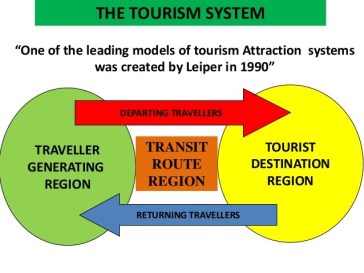
3: The transit route region. This symbolizes the in between places. This could be where the tourist might have visited on the way to their desired destination. It is also the time spend travelling to the destination.
The third component of tourism besides the tourist and the geographical part is the tourism industry consisting of the many various businesses, organizations, and suppliers of the tourism product. You can apply these to Leipers model as well. That means that businesses like tour operators and travel agents would be in the tourist-generating region being the motivators. Other businesses like attractions, hotels and other hospitality businesses are positioned in the tourist destination region. The transport industry is mostly positioned in the transit route region of Leipers model but obviously overlaps in the first and last part as well.
The tourism system has many aspects that all affect each other and are depending on each other.
According to Leiper´s tourism system model there is not only interaction between the tree elements, but also other sectors. Factors such as the ones that produces and delivers the tourism product as well as the many backgrounds that influences tourism activity.
https://opentextbc.ca/introtourism/chapter/chapter-1-history-and-overview/
http://www.shareyouressays.com/93599/3-important-elements-of-tourism
https://www.slideshare.net/RahulKaurav/concept-of-tourism-tourism-system-38391715
http://www.iztzg.hr/en/odrzivi_razvoj/sustainable_tourism/
http://www.hotelresortinsider.com/news_story.php?news_id=139465

